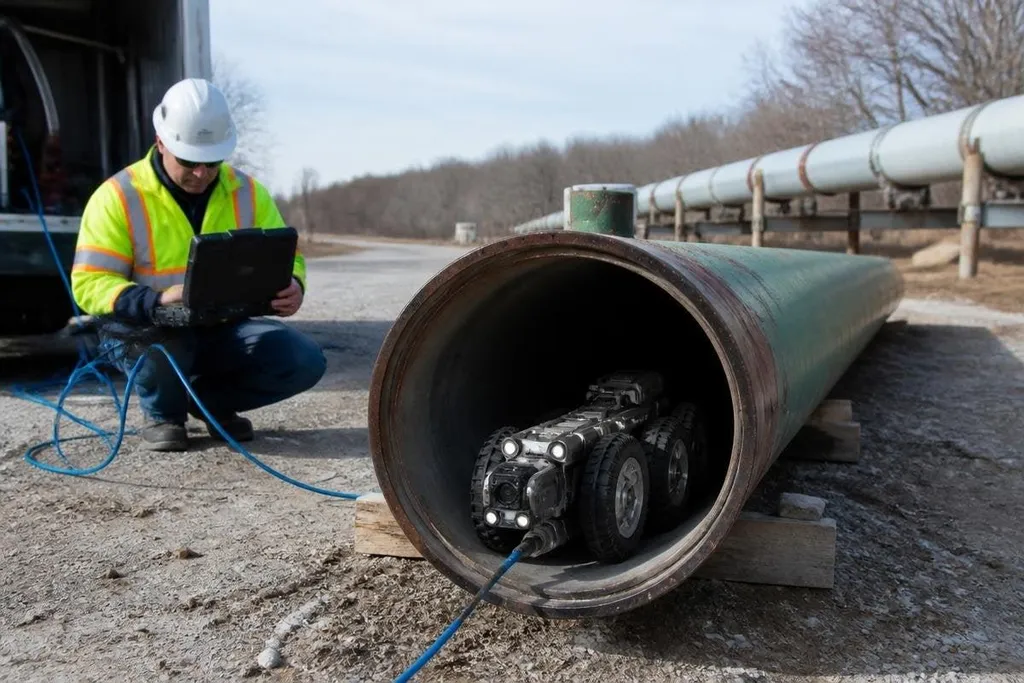
A pipeline robot can inspect sections that are hard, costly, or unsafe for a person to enter. Its value depends on the pipe, the inspection method, and whether the robot can reach the damaged area without help.
If you manage pipeline maintenance, the useful question is not whether robots can inspect pipes. It’s which robot can produce reliable evidence in your pipe.
- Best fit: long pipe runs with known access points and repeatable operating conditions
- Main gain: inspection data without sending a person into a confined space
- Main risk: a robot may miss damage when pipe shape, debris, flow, or sensor contact gets in the way
How pipeline robots inspect damage
Many pipeline inspection tools travel inside the pipe with the product flow. Operators often call them inspection pigs. They can carry sensors that check the pipe wall as the tool moves from one access point to another.
Magnetic flux leakage tools work with steel pipe. A magnet creates a field in the pipe wall, and sensors record changes caused by metal loss. Corrosion can produce that kind of signal, but the data still needs review and a follow-up check before repair work begins.
Ultrasonic tools send sound into the pipe wall and measure the returning signal. This can show wall thickness, but the method needs close sensor contact and a suitable liquid path. A gas pipeline or a pipe with poor internal conditions may need a different inspection method.
Some robots carry cameras instead. A camera crawler can show cracks, deposits, blocked sections, damaged joints, or objects inside a pipe. That picture helps an engineer see the condition directly, though a camera cannot measure every form of wall loss by itself.
Where the benefits are real
The clearest gain comes from access. A robot can inspect a confined space while the operator stays outside, which reduces the need for a person to enter the pipe. Tethered systems can also send live video and power through a cable when a free-moving tool is a poor fit.
Repeat inspections add another benefit. If the same route is checked with the same sensor type, teams can compare new readings with older records. That can help them decide when a section needs repair, a closer inspection, or no immediate work.
Robot inspection also helps when a pipeline cannot be opened across its full length. A crawler may work from one access point through a short section, while an in-line tool can travel much farther when the pipe supports that method.
A stuck crawler can turn an inspection into a retrieval job, so a pipeline operator needs the pipe size, access point, sensor, test date, and recorded fault behind each claim. Pipeline reporting from Robot24.com can put those details beside the machine before the next section examines the risks of lost signals and missed defects.
Where the risks begin
Access limits cause many failures. A robot may need a pipe with a certain diameter, bend radius, surface condition, or entry point. Steps, sharp changes in direction, valves, welds, and heavy deposits can stop a crawler or affect its sensor readings.
Flow creates another problem. An in-line tool must stay with the product or move against it under controlled conditions. If it becomes stuck, the operator may face recovery work, lost production, or the need to open the line.
Sensor data can also be misunderstood. A magnetic signal may point to metal loss without showing the full shape of the defect. A camera view may show corrosion without measuring its depth. Operators need a record of the sensor limits, the inspection path, and any sections the robot could not reach.
Cybersecurity and control links matter for remotely operated systems. A tethered robot can lose video or control if the cable is damaged. A wireless system can lose its connection near metal structures or underground sections. Safety plans should cover those failures before the robot enters the pipe.
Choosing a system for the job
Start with the pipe, not the robot brochure. Gather the route drawings, access points, internal diameter, bend details, product conditions, known deposits, and past inspection records. Then match the inspection method to the defect you need to find.
Use this checklist before approving a deployment:
- Confirm the pipe diameter and every entry and exit point.
- Record bends, valves, welds, reducers, and other internal obstacles.
- Define the damage type the sensor must detect and measure.
- Check whether the pipe can support the robot’s flow, power, and communication needs.
- Set a recovery plan for a stalled or lost robot.
- Require a report that marks inspected, missed, and uncertain sections.
The strongest case is a repeatable route with clear access, a known defect type, and a recovery plan that people have tested on the same pipe design. A difficult route may still justify a robot, but the inspection record should show exactly where confidence ends.
I’d use pipeline robots where they reduce entry risk and produce records engineers can act on. I’d delay deployment when the team cannot explain how the robot will be recovered or how missed sections will be checked.
That decision keeps the machine in its proper role: a tool for finding evidence, not a replacement for engineering judgment.